
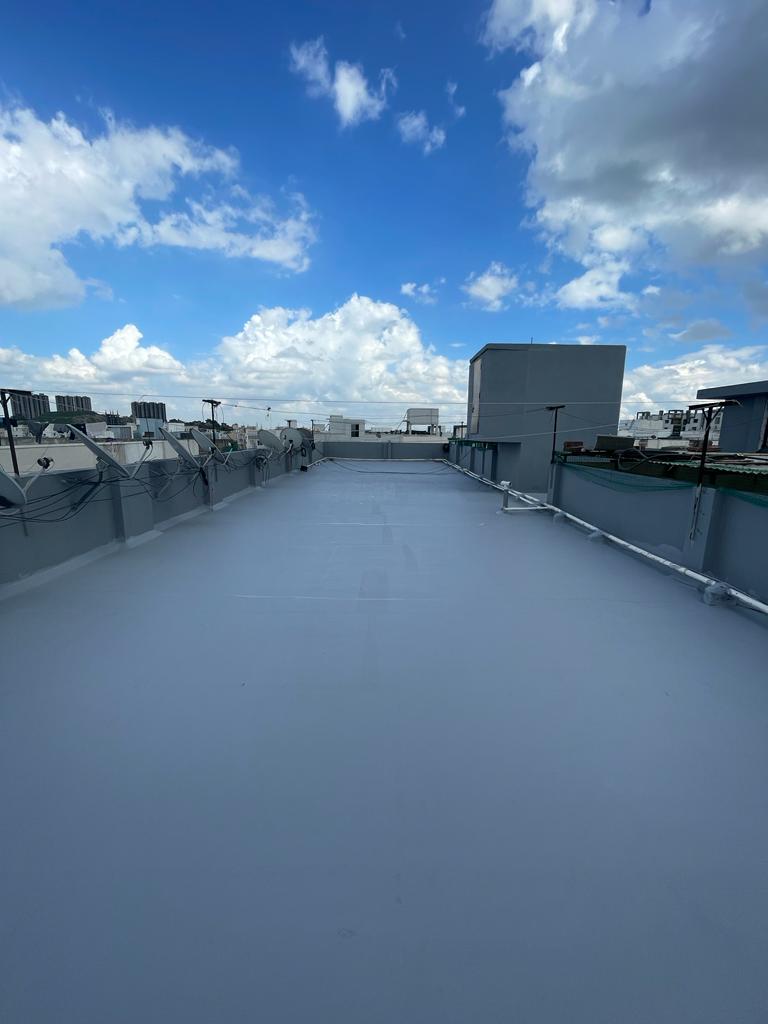
Why terraces in Hyderabad start leaking
The terrace is the single biggest source of seepage in Hyderabad homes. Summer surface temperatures regularly climb past 45°C, then the monsoon arrives with sudden, heavy downpours. That daily cycle of heating and cooling opens hairline cracks in the RCC slab and the old plaster screed, and every crack becomes a path for rainwater into the ceiling below.
Most repeat leaks happen because a coating is painted over a slab that was never properly prepared: loose screed, open joints and blocked outlets are simply covered up. Our terrace waterproofing in Hyderabad starts with fixing the surface, the slope and the drainage, and only then applies the waterproofing layer. If the water is travelling from somewhere unexpected, we trace the leak to its source before quoting.
Signs your roof needs waterproofing
- Damp patches on the top-floor ceilingStains that grow darker after rain, often near corners and beams.
- Peeling paint and plasterPaint bubbling or flaking on the ceiling or the upper part of walls.
- Cracks on the terrace surfaceHairline or map cracks in the screed, especially around parapets and water tanks.
- Water pooling after rainPuddles that stay for hours mean the slope or outlets need correcting.
- Rusty stains or exposed steelA sign water has already reached the reinforcement, which needs urgent attention.
- Musty smell or fungusPersistent dampness in top-floor rooms, wardrobes and false ceilings.
Our terrace waterproofing process
Free inspection & diagnosis
We examine the terrace, the ceiling below, outlets, parapets and tank bases to find exactly where water is getting in.
Surface preparation
Loose screed is removed, the surface is cleaned, and the slope is corrected where water ponds.
Crack & joint treatment
Cracks are opened and filled with polymer-modified mortar or sealant; parapet corners get a coved fillet so the corner can't split.
Waterproofing system
A fibre-mesh reinforced elastomeric coating, APP membrane or PU coating, chosen for your slab, budget and how the terrace is used.
Protective top coat & testing
A UV-stable, heat-reflective finish, followed by a water test and handover with a written warranty.
Terrace waterproofing systems we use
Fibre-mesh elastomeric coating
Flexible liquid coating reinforced with glass-fibre mesh. Stretches over hairline cracks. Ideal for most residential terraces.
APP / SBS bituminous membrane
Torch-applied sheet membrane for large flat roofs and slabs that will be covered with tiles or screed.
PU (polyurethane) coating
Seamless, highly elastic and UV-resistant. Suits terraces with foot traffic and complex shapes.
Brick bat coba
The traditional lime-and-brickbat layer with a waterproof compound, used on new construction for slope and insulation.
Heat-reflective cool-roof coat
White reflective top layer that lowers slab temperature, protects the membrane and keeps top floors cooler in summer.
Our terrace waterproofing work in Hyderabad


Why choose Ganga Waterproofing
- We find the cause, not the symptom. Every job starts with a free inspection to trace the water to where it actually gets in.
- Branded materials, named on your quote. You see exactly which product will be used and how much of it.
- Our own trained crew. The same team starts and finishes your job, and cleans up each evening.
- Written warranty and post-monsoon follow-up. We check back after the first heavy rain.
Read what customers say in our Google reviews, or see recent projects.
Terrace waterproofing across Hyderabad & Secunderabad
We provide terrace waterproofing in all parts of Hyderabad and Secunderabad, including:
Terrace Waterproofing: frequently asked questions
It is priced per square foot and depends on the terrace area, how damaged the surface is and which system is used. A sound slab needing only a coating costs much less than one that needs screed repair and slope correction. After the free inspection you get an itemised quote with the exact products named.
For most homes, a fibre-mesh reinforced elastomeric coating with a heat-reflective top coat gives the best balance of cost and durability, because it moves with the slab in the heat. Large flat roofs or tiled terraces may be better suited to an APP membrane or PU system. We recommend after seeing the slab.
A typical independent house terrace takes 2 to 4 days including surface preparation and curing time between coats. Larger apartment roofs take longer. We give you the schedule before starting.
Coatings need a dry, cured surface to bond. During the rains we can do emergency stop-gap treatment and injection grouting to control an active leak, and complete the full system in the next dry spell.
Not always. If the tiles are firmly bonded, some systems can be applied over them after the joints are treated. Loose or hollow-sounding tiles must be removed, otherwise water keeps travelling underneath.