

Why balconies leak
A balcony is an open slab that takes direct rain, and in many homes it is also used for washing clothes and utensils. If water cannot drain away quickly, it sits on the floor and looks for the weakest point to escape. The most common reasons are:
- No proper slope. The floor is flat or slopes towards the door instead of the drain, so water stands near the threshold.
- Blocked or badly placed drain holes. Leaves and dirt block the outlet, or the outlet sits higher than the floor.
- Open joints at the edges. The joints where the floor meets the walls, railing posts and door frame crack over time and let water in.
- Cracked tiles and open grout. Water seeps through grout lines and hollow tiles into the slab underneath.
- No waterproofing under the flooring. Many balconies were tiled directly on the slab with no waterproof layer.
The damage balcony leakage causes
- Rotting door frames. The bottom of wooden door frames soaks up water, swells, rots and the paint peels away.
- Cracked thresholds. The step under the balcony door cracks and lets more water in.
- Damp walls inside. Water travels into the room wall next to the balcony, causing damp patches, bubbling paint and salt marks.
- Leakage into the flat below. Water through the slab shows up as damp patches or dripping on the ceiling under the balcony.
- Weakened concrete. Over years, moisture rusts the steel in the slab and the concrete starts to crack and flake.
A real example from Hyderabad
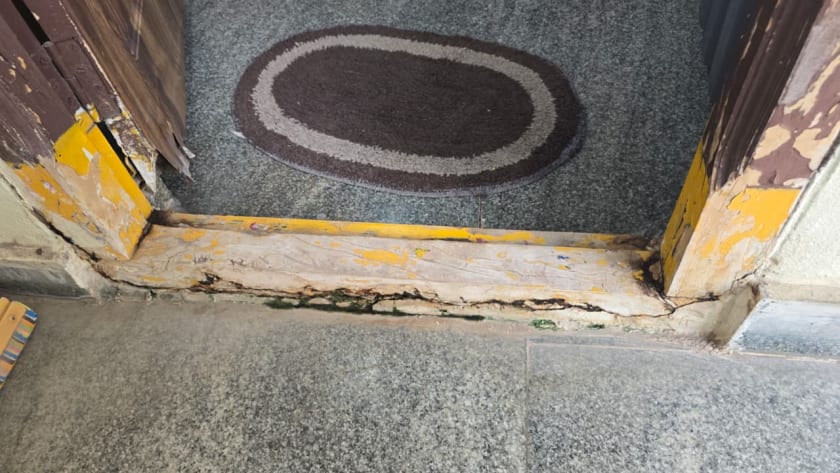
The photo below is from a Hyderabad home we were called to. Water from the balcony had been collecting at the door for a long time: the bottom of the wooden frame has rotted, the paint has peeled off, and the threshold has cracked along its length. This kind of damage keeps getting worse until the balcony itself is waterproofed.
How balcony waterproofing is done
- Inspection. We check the slope, the drain, the joints, the tiles and the damage inside to find where water is getting in.
- Fix the drainage. Drain holes are cleared or reset, and the slope is corrected where needed so water flows away from the door.
- Seal the joints. The floor-to-wall joints, door frame edges and railing posts are cleaned and sealed.
- Waterproof the floor. Depending on the condition, either the tile joints are sealed and a coating is applied, or the old tiles are removed, the slab is waterproofed and new flooring is laid.
- Repair the damage. Once the leak is stopped, the threshold, plaster and paint can be repaired and stay repaired.
Simple checks you can do today
- Pour a bucket of water on the balcony. Does it drain within a few minutes, or does it stand near the door?
- Look at the bottom of the door frame and the threshold for swelling, peeling paint or cracks.
- Check the wall inside, next to the balcony, for damp patches or bubbling paint.
- Ask your downstairs neighbour if they see damp patches under your balcony.
If you see any of these, it is worth fixing now. The dry months are the best time for waterproofing, and the work will be ready well before the next monsoon.
Get your balcony checked
See our balcony waterproofing service, or read about why terraces leak after the monsoon and sump and water tank leakage.
We work across Hyderabad from our office in Anand Nagar, Ramanthapur, including Dilsukhnagar, Secunderabad, Turkayamjal, Suncity and Hayathnagar.
Frequently asked questions
Usually because the floor has little or no slope towards the drain, or the drain hole is blocked or set too high. Water then stands on the floor after rain or washing and slowly finds its way into joints and cracks.
Yes. Water that gets through the balcony floor seeps into the slab and shows up as damp patches, peeling paint or dripping on the ceiling of the balcony or room below. Over time it can also rust the steel in the slab.
Not always. If the tiles are sound and the problem is mainly the joints and edges, the joints can be sealed and a coating applied. If the slope is wrong or tiles are loose and hollow, the old tiles are removed, the slab is waterproofed and new flooring is laid with the right slope.
Most balconies take 1 to 3 days depending on size and whether the tiles need to be replaced, plus curing time. We confirm the timeline in the quote after inspection.